TED TOUR BERLIN
AS INTERFACES FOR INNOVATION AND CREATIVITY
Innovation nowadays is no longer generated in closed environments but increasingly by involving external experts or using open laboratory environments. These developments underline the growing relevance of spaces in bringing together experts from different fields of competence. It needs space and networking for new upcoming models of economic activity, to experiment with ideas and testing of business cases. Especially (so called) FAB LABS act nowadays as interfaces between innovative ideas, teams and companies.
Lab providers and experts from Amsterdam, Barcelona, Linz and Stockholm will not only show their most exciting print outs but also discuss the potentials of a future lab.
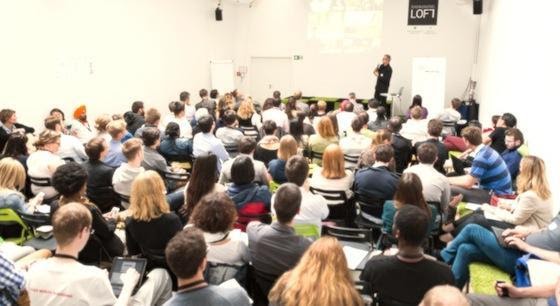
Lab-Betreiber treffen TED-Organisatoren
"We want to contribute to the fact that Labs in Berlin are successfully developing and that they become Berlin’s USP for innovation and cooperation across Berlin borders, ", said Nadine Barthel of the Senate Department for Economics, Technology and Research. How big and great the Lab scene in Berlin is now was shown by Dr. Schmidt Suntje from Leibniz IRS and Nadine Barthel in their presentations, analysis "Innovation and Creative Labs in Berlin - an inventory."
Ivar Björkman
Elizaveta Barsegova from beta house in Berlin pointed out in her presentation on the principles of Open Design City in Betahaus: providing an accessible space for people that are interested. "The best producer is the user," said Frank Kresin from Amsterdam Lab DeWaag Society of his experiences. Ivar Björkman of OpenLab Stockholm called on his supporters to form partnerships with cities.
The panel discussion was between Kresin, Björkman, Horst Hörtner of the Ars Electronica Futurelab in Linz, Tomas Diez of the Fab Lab Barcelona and Wolf Jeschonnek from Berlin's Fab Lab about how partnerships with businesses and other user groups are best designed. Jess Erickson (Berlin Geekettes) was responsible for the moderation.
Afterwards participants where divided in four (workshop) groups. They drew ideas and solutions for labs of the future and discussed how labs can enrich urban ecosystems.
Check out: http://www.berlin.de/projektzukunft/ and http://www.fablab-berlin.org/en/ for more information.